Firmware stop
Klipper Lost Communication With MCU
Lost communication with MCU is a connection evidence problem. Save the exact log text, identify whether it is USB, CAN, power, host load, or firmware/config, then run one safe repeat test before replacing boards or cables.
Independent third-party notes. Verify firmware, heater, electrical, and vendor-specific work against official documentation for your exact printer.
Start here
The MCU link dropped because of USB/CAN communication, power, cable strain, host instability, or firmware/config mismatch.
Lost communication with MCU is a connection evidence problem. Save the exact log text, identify whether it is USB, CAN, power, host load, or firmware/config, then run one safe repeat test before replacing boards or cables.
- Check first
- Copy the exact klippy.log lines and classify whether the first relevant message is USB, CAN, serial reset, or generic lost communication.
- Change only this
- One link variable only: cable/port, host power, CAN termination, toolhead strain, or firmware UUID/config.
- Verify with
- A 10-minute idle test and a short safe motion test that previously reproduced the drop.
- Time
- 7-12 min log and idle test
- Risk
- Caution
- Needs purchase
- No purchase until the same evidence repeats after one controlled test.
Pick what you see
Pick the Klipper Lost Communication With MCU branch
Choose the visible evidence or log clue that matches first. The card below keeps the next move to one test and one variable.
Klipper shows a specific Klipper Lost Communication With MCU message or repeats one exact line in klippy.log.
- Likely cause
- The subsystem named by the earliest matching log line.
- First test
- Save 60 seconds before and 30 seconds after the timestamp.
- Change only this
- Change no firmware setting until the same line is classified.
- Parameter range
- 10-15 minutes with log capture
- Stop when
- The same safe test passes twice with clean logs.
- Verify with
- Log snippet + safe idle or motion repeat.
Exact error lookup
Paste the Klipper message into the matching branch first.
| Error text | Likely subsystem | First evidence | Do not do | Safe verification |
|---|---|---|---|---|
| Lost communication with MCU | USB/CAN/power link | First disconnect line and MCU name | Do not reflash every board first | 10 minute idle link test, then one motion test |
| Timer too close | Host timing or motion load | Timestamp, host load, recent macros, and motion context | Do not copy random timer or scheduling settings | Repeat the same section with one load variable changed |
| Heater not heating at expected rate | Heater/sensor/power path | Heater graph, config pin, wiring, and exact heater name | Do not bypass heater safety | Controlled low-risk heat test after inspection |
| ADC out of range | Thermistor or sensor wiring | Sensor name, temperature reading, connector state | Do not keep heating | Cold reading check and inspected wiring before heat |
| Config error after printer.cfg edit | Config syntax or pin mapping | Last changed config block and error line | Do not edit multiple blocks at once | Rollback one block and restart/check config |
Pick the exact path
Most failed fixes go wrong when they start from the wrong branch.
Use this when the failure appears on Klipper or the closest matching setup.
- First test
- Save 60 seconds before and 30 seconds after the timestamp.
- Change only this
- Change no firmware setting until the same line is classified.
- Stop when
- The repeat test clearly improves or points to a different branch.
Use this if the symptom started after a nozzle, spool, plate, slicer, firmware, or maintenance change.
- First test
- Restore the last known-good context or isolate only the recent change with one small repeat test.
- Change only this
- Undo or isolate the recent change; do not retune the whole profile.
- Stop when
- The repeat test clearly improves or points to a different branch.
Use this when the first proof test looks the same after one safe variable change.
- First test
- Repeat the same test once to rule out a bad slice or one-off print.
- Change only this
- Switch branch instead of stacking another setting.
- Stop when
- The repeat test clearly improves or points to a different branch.
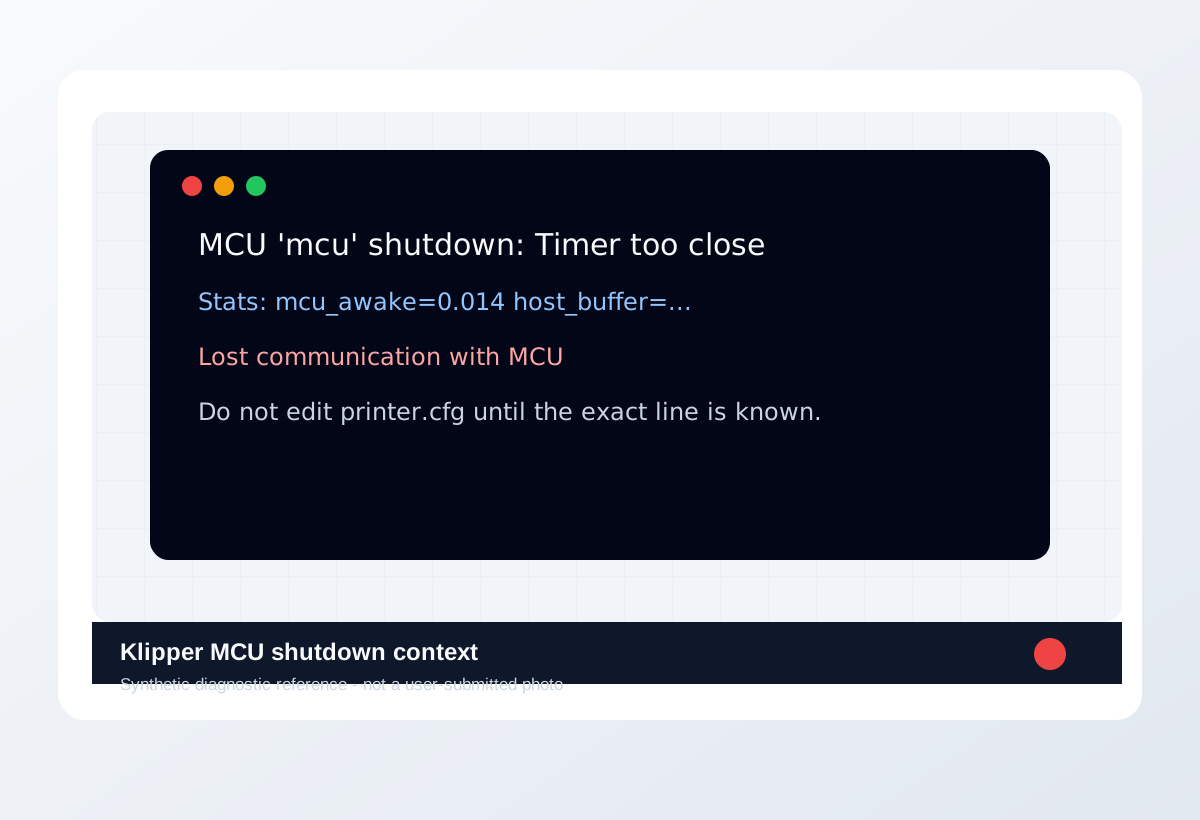
Visual diagnosis
Match the visible pattern before changing settings.
Synthetic diagnostic reference or structured visual guide; confirm with the page test before treating it as proof.
- Klipper Lost Communication With MCU repeats on the same printer, material, or print condition.
- The visible pattern changes when one branch variable changes.
- The symptom can be reproduced with a small test instead of a full model.
- The log is primarily heater not heating, ADC out of range, or thermal runaway behavior.
- The only symptom is a visible layer shift with no Klipper disconnect message.
- You already changed several hardware and firmware variables without a clean before/after log.
- Later log lines that are not the first fault
- A visible print defect with no matching log
- Config guesses copied from another printer
- Where the defect starts and whether it repeats at the same location.
- Whether the texture is smooth, rough, lifted, thin, blobby, or shifted.
- What changed recently: material, nozzle, plate, firmware, slicer, or printer maintenance.
- The exact slicer value that caused it.
- Whether the spool is dry, the nozzle is worn, or the config is correct.
- That a purchase is needed before the same small test is repeated.
Original visual references
Synthetic examples for fast pattern matching.
These are Print Fixes synthetic diagnostic references, not user-submitted photos. Use them to compare shape and location, then confirm with the test or log evidence on this page.
Recommended Checks
0/6 doneVerification
- The same idle or motion test passes twice with no new disconnect lines in klippy.log.
- If the disconnect follows motion only, moving the cable chain by hand or slowing the same path changes the result.
- If the disconnect happens idle, power, USB/CAN adapter, firmware, or host stability stays the active branch.
- If changing a cable fixes the link, keep the old cable out of the printer and document the timestamp before/after.
Field guide
Follow the branch that matches your print
Klipper shows a specific Klipper Lost Communication With MCU message or repeats one exact line in klippy.log.
- Likely cause
- The subsystem named by the earliest matching log line.
- First test
- Save 60 seconds before and 30 seconds after the timestamp.
- Change only this
- Change no firmware setting until the same line is classified.
- Verify with
- Log snippet + safe idle or motion repeat.
- Stop when
- The same safe test passes twice with clean logs.
The printer disconnects while idle or during heat soak before motion starts.
- Likely cause
- Power, USB/CAN link, host stability, or firmware identity.
- First test
- Run a 10 minute idle connection test with no print.
- Change only this
- Change only cable/port/power path or host load for one repeat.
- Verify with
- Idle log comparison.
- Stop when
- No disconnect appears in two idle repeats.
The error appears near fast motion, toolhead cable movement, or a repeated print height.
- Likely cause
- Cable strain, CAN link, host timing, or motion load.
- First test
- Run a short safe motion section without a full print.
- Change only this
- Change only cable strain relief, route, acceleration, or host load.
- Verify with
- Same motion repeat with klippy.log.
- Stop when
- The error no longer follows that motion path.
The failure started immediately after printer.cfg, macro, firmware, or UUID changes.
- Likely cause
- Config syntax, pin mapping, UUID mismatch, or unsafe copied snippet.
- First test
- Diff the last known-good config against the current one.
- Change only this
- Revert or isolate one config block only.
- Verify with
- Restart + config check + safe home/idle test.
- Stop when
- The exact message disappears after one config rollback.
The log includes heater, ADC, thermistor, or temperature language.
- Likely cause
- Sensor/heater wiring, config, or safety fault.
- First test
- Stop printing and inspect the exact heater/sensor row first.
- Change only this
- Do not bypass safety limits; change only the proven wiring/config item.
- Verify with
- Controlled low-risk heat test after inspection.
- Stop when
- Temperature rises normally and log stays clean.
Concrete Parameter Range
| Setting | Start | Range | Change when | Stop when | Too far looks like |
|---|---|---|---|---|---|
| Idle connection test | No print | 10-15 minutes with log capture | Disconnect occurs before motion or heat | Clean log after two repeats | Treating one clean idle as print-safe |
| Safe motion test | Short controlled move | Repeat same path, no full print first | Error follows motion/cable position | Same motion passes twice | Testing heat, motion, macros, and print load together |
| Host load | Current host services | Disable one load source for proof | Timer or communication error appears under load | Log stays clean with one load variable changed | Buying host hardware before log evidence |
| Config rollback | Last known-good config | One block at a time | Error began after edit/flash/UUID change | Config check and safe test pass | Copying snippets across printers |
Material / Machine Differences
Wrong Turns
Stop tuning when
Do not keep chasing perfection after the signal is clear.
- The same small test improves after one documented change.
- The symptom turns into a different failure family; switch branches instead of stacking edits.
- A safety, heater, wiring, or firmware warning appears; stop printing and use the safe diagnostic path.
Common setups
Jump to the branch that matches your machine or material
Copy before changing more settings
Klipper lost communication brief
Fill this out after the first test so the next branch is based on evidence, not memory. The useful case is the one where only one variable changed.
Printer:
Host:
Firmware:
MCU path USB/CAN:
Adapter/cable:
Exact error:
Timestamp:
What was happening:
Idle test:
Motion test:
One change tested:
Result:Still not matching?
Jump to the next likely diagnosis
Problem Pattern
Klipper stops with language such as lost communication with MCU, mcu disconnected, serial reset, CAN timeout, invalid bytes, or toolhead board disconnect. The print symptom matters less than the log timestamp and which link dropped.
Likely Causes
- USB cable, hub, ferrite, or power instability resets the MCU link.
- CAN wiring, termination, bitrate, UUID, or adapter path drops under motion or heat load.
- Toolhead cable strain or connector movement opens briefly during fast motion.
- Host load, storage stalls, undervoltage, or background services starve the connection path.
- Firmware, UUID, or config mismatch appears after flashing or printer.cfg edits.
Print Context
- Applies to
- Klipper printers using USB serial MCUs or CAN toolhead boards
- Best first move
- Copy the exact klippy.log lines around the disconnect before rebooting everything.
- Do not start with
- Reflashing every board or buying a new MCU before the same disconnect repeats.
After the test
Use the result, do not keep changing random settings.
If one check clearly changes the print, repeat that exact test once before moving on. If nothing changes, switch diagnosis instead of stacking more slicer edits.
Warnings
- Do not bypass heater, thermistor, or safety shutdown logic to keep printing.
- Do not reflash multiple boards at once; it destroys the evidence trail.
- Power off before reseating boards, CAN wiring, or toolhead connectors.
- A timer-too-close error near a disconnect does not prove the host is bad; match the earliest relevant log line.
- Klipper console or klippy.log says lost communication, serial reset, CAN timeout, or MCU disconnect.
- The failure repeats around the same motion, cable position, heat-up, or host workload.
- The log is primarily heater not heating, ADC out of range, or thermal runaway behavior.
- The only symptom is a visible layer shift with no Klipper disconnect message.
More traps to avoid
- Buying a new board when the old USB cable or host power supply is the repeating evidence.
- Treating CAN timeout, USB serial reset, and timer too close as the same fault.
- Testing by running a full print before a safe idle/motion proof test.
Bench Note
Exact error text:
MCU name:
USB or CAN path:
Timestamp:
What was happening 60s before stop:
Idle test result:
Motion test result:
One variable changed:
After-test log result:
FAQ
Should I replace the MCU board first?
No. Replace hardware only after the same idle or motion test points to that link. Most first checks are cable, power, strain, CAN termination, host load, or firmware/config evidence.
Is CAN disconnect the same as lost communication with MCU?
It is one subtype. CAN adds termination, bitrate, UUID, adapter, and toolhead cable variables that USB-only printers do not have.
Can I keep printing after one disconnect?
Treat it as a real stop. Save the log and run a safe repeat test; do not bypass Klipper shutdown behavior.